
What is alopecia?
The medical term for hair loss is alopecia. There may be associated scalp disease or scarring.
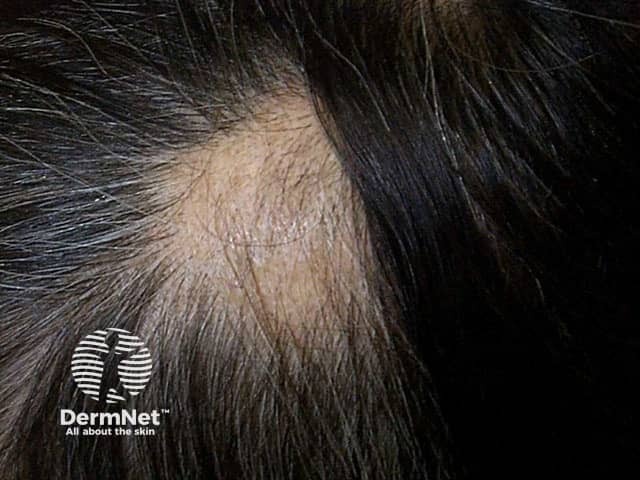
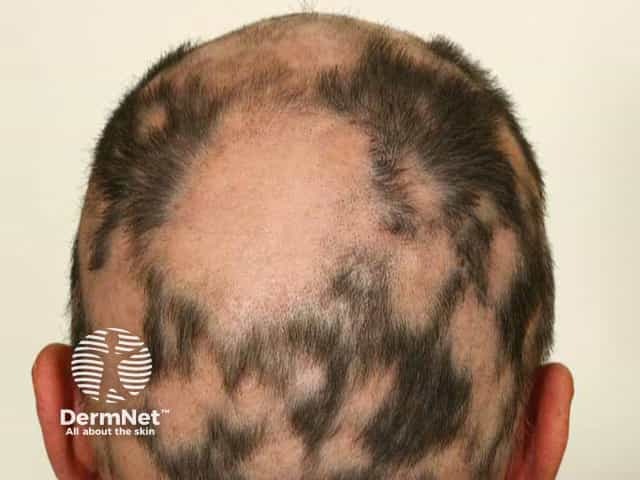
- Alopecia may be localised (a small area) or diffuse (affecting most/all of the area), or patterned (as occurs in male-pattern baldness with recession at the temples and crown loss).
- Hair loss can result from any scarring process affecting the skin (such as a burn, trauma or a scarring disease).
-
It can affect the scalp or other parts of the body, such as the beard, eyebrows, and eyelashes.
-
It may be due to hair shedding, poor quality hair, or hair thinning.
-
There may be areas of skin that are completely bald.
-
There may be associated skin disease or scarring.
How does hair grow?
Hair grows on most parts of the skin surface, except palms, soles, lips and eyelids. Hair thickness and length varies according to the site.
-
Vellus hair is fine, light in colour, and short in length
-
Terminal or androgenic hair is thicker, darker and longer
A hair shaft grows within a follicle at a rate of about 1 cm per month. It is due to cell division within the hair bulb at the base of the follicle. The cells produce the three layers of the hair shaft (medulla, cortex, cuticle), which are mainly made of the protein keratin (which is also the main structure of skin and nails).
Hair growth follows a cycle. However, these phases are not synchronised, and any hair may be at a particular phase at random.
The phases of the hair cycle are:
-
Anagen (growth phase): active growth of most hairs
-
Catagen (transition phase): 2–3 weeks when growth stops and the follicle shrinks, 1–3% of hairs
-
Telogen (resting phase): 1–4 months, up to 10% of hairs in a normal scalp
-
Exogen (shedding phase)
Hair length depends on the duration of anagen. Short hairs (eyelashes, eyebrows, hair on arms and legs) have a short anagen phase of around one month. Anagen lasts up to 6 years or longer in scalp hair.
What causes hair loss?
Hair loss can be due to:
-
The decreased growth of the hair: anagen hair loss
-
Increased shedding of the hair: telogen hair loss
-
Conversion of thick terminal hairs to thin vellus hairs; male and female pattern hair loss
-
Congenital or acquired hair shaft abnormalities
-
An inflammatory skin disease that damages or destroys the hair bulb.
What is alopecia areata?
Alopecia areata is an autoimmune condition affecting hair follicles causing non-scarring hair loss. It typically presents with discrete bald patches on the scalp but can cause hair loss from all hair-bearing areas on the body.
Alopecia is a Latin term meaning hair loss, and areata refers to the patchy nature of the hair loss. The term alopecia areata is considered an umbrella term.
What causes alopecia areata?
The exact mechanism responsible for hair loss in alopecia areata remains unclear. It is hypothesised that loss of immune privilege in anagen hair follicles plays a key role in the pathogenesis, allowing an individual's own immune system to attack the growing hair. Genetic susceptibility is also thought to contribute. Small areas of alopecia areata may regrow spontaneously, larger, extensive and longstanding patches are less likely to regrow without treatment.


Post your comment
Comments
7 October 26
Raj Shekar
Good to know the pathophysiology of hair loss.
Could you please let us know how to treat hair loss, because it is a common presentation in our practice.
7 October 26
DermNet
Thank you for your comment. Please find treatment information on the full topic page (hyperlinked above).
28 September 26
Ghazala
Great read. Please post an article about androgenetic hair loss in men and women and latest treatment strategies that are evidence based.
24 September 26
Kathryn
Thanks for another great article.
Patchy alopecia is secondary syphilis is another cause that warrants consideration
24 September 26
Lorraine Smith
Thank you for the post. Information on latest effective treatments for severe alopecia arrests would be very useful
Is PRP or exosomes any use? Which Jak inhibitor is most effective ?
30 September 26
DermNet
The hyperlinks can be found above (first mentions of 'hair loss' and 'alopecia areata'). Alternatively, you can locate these pages directly on DermNet.
25 September 26
Héctor
Where is said hyperlink?
Thanks.
25 September 26
DermNet
Thank you for your comment. Please find treatment information on the full topic page (hyperlinked above).
23 September 26
Dr Jon K
I would have thought that some of the potential treatment options/approaches would have enjoyed a mention.
24 September 26
DermNet
Thank you for your comment. Please find treatment information on the full topic page (hyperlinked above).
No one has commented on this page yet.