
What is erythema multiforme?
Erythema multiforme is an immune-mediated, typically self-limiting, mucocutaneous condition characterised by ‘target’ lesions. Significant mucosal involvement distinguishes erythema multiforme major from multiforme minor. Episodes can be isolated, recurrent, or persistent.
Who gets erythema multiforme?
Erythema multiforme affects less than 1% of the population. It is most common in young adults (aged 20–40 years) with a modest predominance in males. There is no association with race.
There appears to be a genetic predisposition in people carrying the HLA-DQB1*0301 allele, which shares an even stronger association with herpes-related erythema multiforme. Multiple other alleles have been associated with its recurrent form.
What causes erythema multiforme?
Infection precipitates 90% of cases, with HSV type 1 being the predominant cause. Other infectious triggers include:
-
HSV type 2
-
Cytomegalovirus
-
Epstein-Barr virus
-
Influenza virus
-
Vulvovaginal candidiasis
-
SARS-CoV-2
-
Orf.
Medications that may trigger erythema multiforme include antibiotics, anti‑epileptics, NSAIDs, and vaccinations (most common cause in infants). Other conditions associated with erythema multiforme, especially persistent disease, include inflammatory bowel disease, hepatitis C, leukaemia, lymphoma, and solid organ malignancies.
What are the clinical features of erythema multiforme?
Many patients report prodromal symptoms including fatigue, malaise, myalgia, or fever. These likely represent the course of precipitating illness rather than true prodrome.
Cutaneous features
-
Cutaneous lesions develop at the peripheries before spreading centrally.
-
Distribution is usually symmetrical with a preference for extensor surfaces.
-
May be painful, pruritic, or swollen.
-
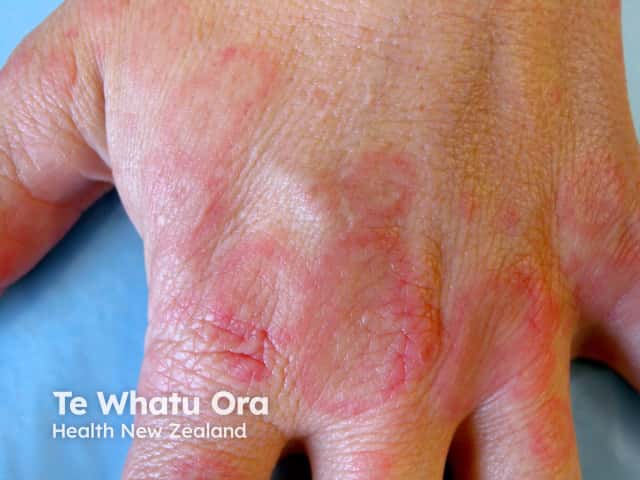
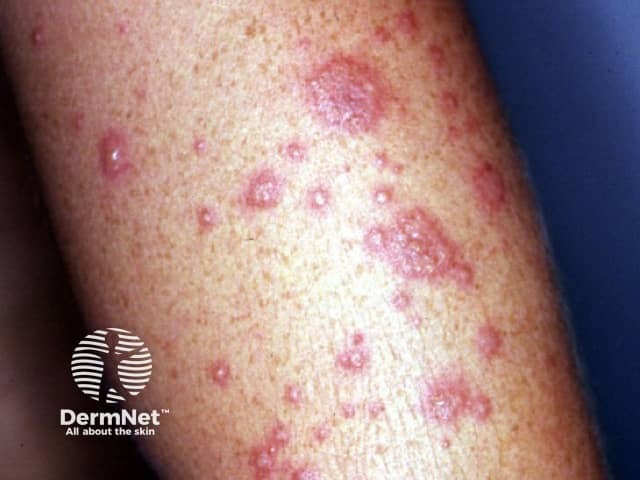
Early lesions present as round, erythematous papules which later develop into target lesions.
-
Atypical lesions may be present with typical lesions. Atypical lesions are raised with poorly defined borders and/or fewer zones of colour variation.
-
In severe disease, up to hundreds of lesions may be present in different developmental stages, at times making it difficult to identify characteristic lesions.
Mucosal features
-
Lesions develop as blisters, which then break to reveal shallow erosions with a white overlying pseudo-membrane.
-
Erythema multiforme favours oral membranes, but may also present with urogenital and, rarely, ocular lesions.
-
Mucous membrane involvement can be painful and significantly limit oral intake; lesions may precede or follow cutaneous lesions.
Symptoms are expected to self-resolve within 4 weeks from onset (or up to 6 weeks in severe disease).


Post your comment
Comments
19 October 26
Razan
Good
5 September 26
Murray
Hard to see the "target" appearance on the second image .Probably easier to work out if seeing face to face
24 August 26
Albert
Note that urticaria is often mislabelled as erythema multiforme, as the lesions are sometimes circular. I have seen this many times
22 August 26
Jamil
Treatment should be added
31 August 26
DermNet
Thank you for your comment. Please see the full page on erythema multiforme for treatment details.
25 August 26
Nancy
There is no treatment, it's self limiting
21 August 26
Karen
Excellent explanation of the illusive erythema multiforme and noting likely viral triggers
20 August 26
Mohamed
Mycoplasma infection also is one of the infection causes
Thanks
20 August 26
LIUDMILA
Thank you for the reminder and the explanation of the causes of erythema multiforme, beyond drug hypersensitivity and HSV-1.
19 August 26
Joana Sousa
Congratulations. Very Good site, clear and simple information with ilustrative figures
19 August 26
Ben
Nice explanation,
19 August 26
Abdul Nasir Azizi
Important information about Erythema multiforme.
Thanks
No one has commented on this page yet.