
Case: 26-year-old with spots on her back
Background
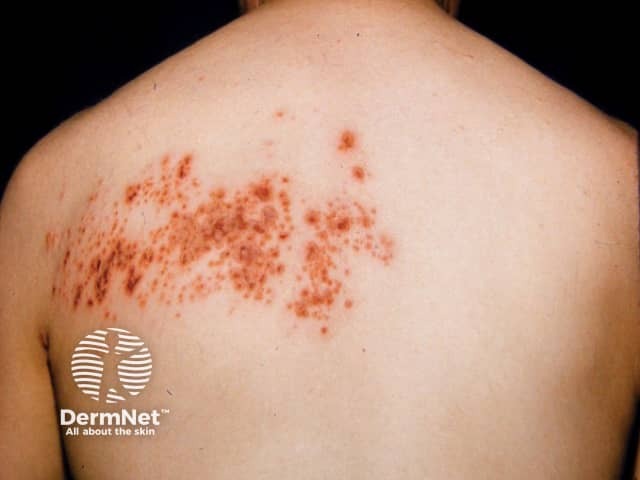
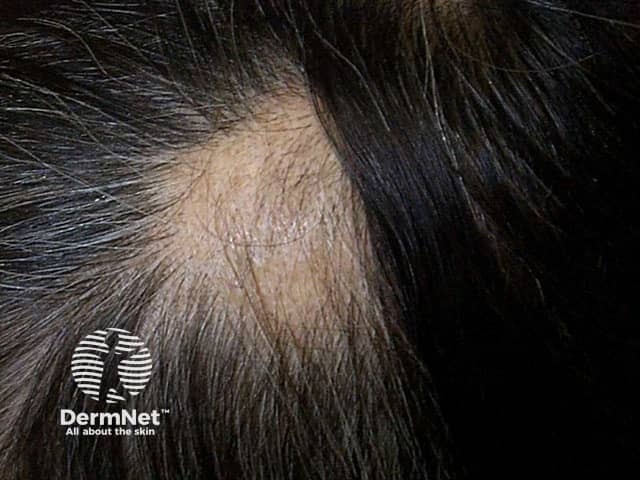
This 26-year-old woman is concerned about spots on her back. They are not particularly itchy or painful, but their presence limits the kind of clothing she can wear. She would like for them to clear up before her forthcoming wedding. She also has scaling on the nasolabial folds and scalp.

What is this condition?
The image shows monomorphic papules over the interscapular area. There are no comedones, and there is no variety in the size and shape of lesions as one sees in acne. These features all suggest Malassezia (pityrosporum) folliculitis. The condition results from the overgrowth of pityrosporum yeasts within the hair follicles.
Humidity, heat, seborrhoea, immunosuppression, and HIV contribute to the overgrowth of the yeasts. The back is the most frequently affected area; it can also occur on the chest. It is often associated with seborrhoeic dermatitis in other sites.
How can this be confirmed?
Routine bacteriology from affected follicles is negative as the causative yeasts require very specialised culture media to grow them. They are most easily visualised on biopsy.
Suggest topical and systemic treatment options:
Topical antifungals such as selenium sulfide shampoo, or azoles such as econazole lotion or ketoconazole shampoo, can be helpful both in initial treatment and recurrence prevention. Oral fluconazole or itraconazole are sometimes more convenient to use.
For more information on this condition and its management, see Malassezia folliculitis.



Post your comment
Comments
14 October 26
Sima Singh
Nice case presentation
14 October 26
Sima Singh
Good information to practice with
7 October 26
Janan
Very interesting case, a lot of learning so helpful
6 October 26
CHRISTOPH
A smear stained with methylene blue for one minute (not ten seconds!) shows the yeast very clearly. In my practice, the treatment of choice is isotretinoin at a dose of 5 or 10 mg per day until clearance (2–3 months). Local treatments do not penetrate the greasy content of the follicles, and resistance to azole antifungals is common.
3 October 26
JACO
Great case
2 October 26
Ayinke
The papular rashes might be mistaken for acne and this might change the management entirely
2 October 26
Maia
Thank you, this is a very interesting and relevant case
2 October 26
Roy
A differential diagnosis is necessary
For example milliaria rubra.
1 October 26
Günther
Most grateful for the informative report, thank you.
30 September 26
Charles
How would this present on a darker skin? Any photos??
1 2 next »
No one has commented on this page yet.